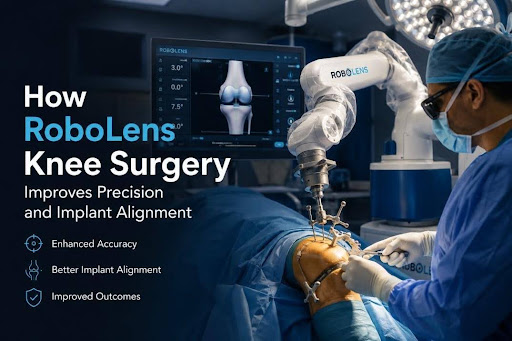

Knee replacement surgery has evolved significantly with the introduction of advanced technologies designed to support greater surgical accuracy and personalized treatment. One such development is RoboLens knee surgery, which uses advanced visualization and guidance to help surgeons assess knee anatomy, plan the procedure, and achieve accurate implant positioning.
For patients considering knee replacement in Panchkula, understanding how modern technology can support surgical precision is important. Correct implant alignment is one of the key considerations during knee replacement because it can influence joint stability, movement, load distribution, and the long-term performance of the artificial joint.
What Is RoboLens Knee Surgery?
RoboLens knee surgery is an advanced technology-assisted approach designed to provide surgeons with enhanced visual and positional information during knee replacement procedures.
Rather than replacing the surgeon’s expertise, the technology acts as a guidance system. It can help the surgical team visualize relevant anatomical landmarks, assess alignment, and make precise adjustments during different stages of the operation.
The objective is to combine advanced technology with the surgeon’s clinical judgment to create a more personalized and controlled surgical process.
Why Implant Alignment Matters in Knee Replacement
A knee implant consists of several components that need to work together with the patient’s bones and surrounding soft tissues. Proper positioning and alignment are essential for achieving balanced joint mechanics.
If components are not positioned appropriately, the knee may experience uneven loading or instability. Over time, these factors may contribute to discomfort, abnormal wear, or reduced implant performance.
This is why surgeons carefully evaluate the patient’s natural anatomy and alignment before and during surgery.
How RoboLens Supports Surgical Precision
1. Enhanced Visualization of Knee Anatomy
One of the key advantages of RoboLens knee surgery is the ability to provide enhanced visualization during the procedure.
Advanced digital guidance can help the surgeon identify key anatomical landmarks and understand relationships among knee structures.
This additional information can support more accurate surgical decisions, particularly during bone preparation and implant positioning.
2. Personalized Surgical Planning
Every knee has a unique anatomy. Patients can have differences in bone shape, joint alignment, deformity, and soft-tissue characteristics.
RoboLens-assisted procedures can incorporate patient-specific information into the surgical plan. This allows the surgeon to develop an approach tailored to the individual’s anatomy rather than relying entirely on generalized measurements.
Personalized planning is particularly valuable when treating patients with significant deformity or complex knee anatomy.
3. Improved Implant Positioning
Implant positioning is a critical stage of knee replacement. The artificial components must be placed at appropriate angles and locations to support proper joint mechanics.
RoboLens technology can provide real-time guidance during implant positioning, helping the surgeon assess alignment and make adjustments when necessary.
This additional guidance may help minimize variations during surgery and support more consistent implant placement.
4. Support for Accurate Bone Preparation
Before an implant is placed, damaged portions of bone need to be carefully prepared.
The amount and angle of bone preparation can influence final implant positioning. Advanced visualization and guidance can assist the surgeon in evaluating these measurements during the procedure.
By supporting precise bone preparation, RoboLens can contribute to the overall alignment strategy.
5. Better Assessment of Knee Alignment
Knee alignment plays an important role in how forces are distributed across the joint.
RoboLens technology can provide information that helps the surgeon assess alignment throughout the procedure. This may be particularly useful when correcting pre-existing deformities associated with advanced arthritis.
The surgeon can use this information alongside clinical experience and other surgical assessments to determine the appropriate positioning of the implant.
RoboLens and Soft-Tissue Balance
Successful knee replacement is not solely dependent on bone alignment. Ligaments and other soft tissues surrounding the knee also contribute to stability and movement.
During surgery, the surgeon evaluates the balance of these structures. Technology-assisted guidance can provide additional information that supports this assessment.
A balanced knee can contribute to:
- Improved stability
- Smoother movement
- Better functional recovery
- More natural-feeling joint mechanics
The exact approach depends on the patient’s anatomy and the surgical technique being used.
Can RoboLens Improve Implant Longevity?
Implant longevity depends on several factors, including implant quality, surgical technique, patient activity, body weight, bone health, rehabilitation, and long-term joint care.
Accurate positioning is one important component. When an implant is appropriately aligned, forces can be distributed more effectively across the joint.
By supporting accurate alignment and positioning, RoboLens knee surgery may contribute to the factors associated with successful long-term implant performance. However, no technology can guarantee a specific implant lifespan or surgical outcome.
Is RoboLens Knee Surgery Suitable for Everyone?
Not every patient undergoing knee replacement necessarily requires technology-assisted surgery.
The suitability of RoboLens depends on factors such as:
- Severity of arthritis
- Knee deformity
- Individual anatomy
- Previous knee surgery
- Bone condition
- Type of knee replacement planned
- Surgeon’s assessment
A detailed clinical evaluation is essential before deciding which surgical approach is most appropriate.
Choosing an Experienced Knee Specialist
Advanced technology is most effective when combined with appropriate surgical expertise. Patients should therefore consider the surgeon’s experience with knee replacement, understanding of modern surgical techniques, hospital infrastructure, and rehabilitation support.
Patients researching knee replacement in Panchkula can consult Dr Vivek Bhatia to discuss whether RoboLens-assisted surgery is appropriate for their specific condition and understand how the technology will be used during the procedure.
A personalized consultation can also help patients understand the expected benefits, limitations, recovery process, and potential risks.
For patients exploring advanced knee replacement care in Panchkula, Chandigarh and nearby areas, Orthomax 3D Knee Hospital Panchkula can be considered as a source of specialized knee-care guidance and treatment planning.
Recovery After RoboLens Knee Surgery
The recovery process following RoboLens-assisted knee replacement generally involves the same fundamental principles as other modern knee replacement procedures.
Patients may begin assisted movement soon after surgery, followed by a structured rehabilitation program. Physiotherapy typically focuses on restoring:
- Knee range of motion
- Muscle strength
- Balance
- Walking ability
- Functional independence
Recovery timelines vary between individuals. Age, physical condition, muscle strength, the complexity of surgery, and adherence to rehabilitation can all influence progress.
The Future of Precision Knee Replacement
Technology-assisted surgery continues to develop, with increasing emphasis on personalized planning, accurate measurements, and real-time surgical guidance. RoboLens knee surgery represents one approach that can help surgeons integrate advanced visualization into modern knee replacement.
Its greatest value lies not simply in the technology itself but in how it supports the surgeon’s ability to make informed, patient-specific decisions.
Conclusion
Accurate implant positioning and alignment are fundamental goals of successful knee replacement surgery. RoboLens knee surgery can support these goals by providing enhanced visualization, personalized planning, real-time guidance, and additional information during critical stages of the procedure.
For suitable patients, this technology can complement surgical expertise and help create a more precise and individualized knee replacement experience. Patients considering knee replacement in Panchkula should discuss their condition, treatment options, and the potential role of RoboLens technology with an experienced knee specialist to determine the most appropriate approach for their individual needs.